Claude Managed Agents returned a list cost of zero for our successful session on 19 November 2026. It wasn't free: reconstructing the tokens, cache traffic and running time gives about $0.00176. I checked Anthropic's Managed Agents documentation that day to separate what you pay the platform from what you still have to operate yourself.
The short answer: choose the hosted service when you want Anthropic to operate the agent loop and sandbox. Choose your own Messages API loop when execution control justifies owning the runtime. At the measured task's usage, 10,000 sessions would cost about $17.56 on Managed Agents; an owned loop would spend $15.72 on tokens before hosting. These are estimates, not guaranteed invoices or equivalent-output benchmarks.
What does Claude Managed Agents pricing include?
Claude Managed Agents pricing adds model tokens, session running time and paid web searches. Calculate each separately so a cheap model doesn't hide an expensive tool habit.
monthly managed cost = model token cost
                     + running seconds / 3600 × $0.08
                     + web searches / 1000 × $10
Anthropic meters runtime while the session is running; idle, rescheduling and terminated time don't count. A session waiting for a tool confirmation is idle. Cached input has its own rates, and Messages API batch discounts don't apply to sessions. (Anthropic pricing, checked November 2026)
What would you pay to operate this workload yourself? Removing the runtime fee doesn't remove the token bill, sandbox maintenance or incident response. Keep the hosting line separate even when you use a machine you already own.
What did one real session cost?
Our TODO-listing session completed with about $0.00157 in model consumption and $0.00018 in runtime. Its reported list_cost.amount was "0"; the API exposes that amount as whole cents, so use the usage counters when investigating a sub-cent run. (Anthropic usage reference, checked November 2026)
The measurement used macOS, Python 3.12.14, anthropic SDK 2.10.0 and claude-haiku-5-5 on 19 November 2026. The task created a fixture repository, listed comment TODOs and wrote TODO.md. It found all seven intended TODOs and skipped the non-comment trap, though it kept the TODO: prefix in the extracted text. This was one fixture run, not evidence about production reliability.
The first non-user event arrived 0.5 seconds after sending the message. The session went idle after 8.4 seconds; billable usage.active_seconds was 8.31. Total script time, including resource creation and retrieval, was 13.4 seconds. Don't price runtime from that last number.
| Component | Measured quantity | Rate per million tokens, unless stated | Calculated USD |
|---|---|---|---|
| Uncached input | 8 tokens | $0.10 | $0.0000008 |
| Five-minute cache creation | 6,589 tokens | $0.125 | $0.0008236 |
| Cache reads | 11,072 tokens | $0.01 | $0.0001107 |
| Output | 1,273 tokens | $0.50 | $0.0006365 |
| Runtime | 8.31 seconds | $0.08/hour | $0.0001847 |
| Total | One session | About $0.00176 |
The rates match Anthropic's Haiku 5.5 tier for prompts up to 100,000 tokens. Costs scale with the model and prompt tier; do not carry this dollar total over to Opus or a longer prompt. (Anthropic model pricing, checked November 2026)
What would three monthly workloads cost?
Repeating that exact usage at three hypothetical volumes gives the estimates below. The comparison holds tokens constant across platforms to isolate billing; I did not run the task on the other two setups.
Every session assumes the measured cache writes and reads, 8.31 seconds of running time, and no web searches. Each session rebuilds the measured cache pattern; there is no assumed cache sharing between jobs. There are no retries, discounts, premium inference modes or geographic premiums. The owned-loop column adds an illustrative $20 monthly box, not a provider quote or a claim that it can sustain the workload.
| Monthly workload | Sessions | Managed Agents | Own Messages API loop, including $20 box | Octomind pro scenario |
|---|---|---|---|---|
| Pilot | 100 | $0.18 | $20.16 | $50.00 |
| Queue | 10,000 | $17.56 | $35.72 | $50.00 |
| Volume | 100,000 | $175.63 | $177.16 | $187.94 |
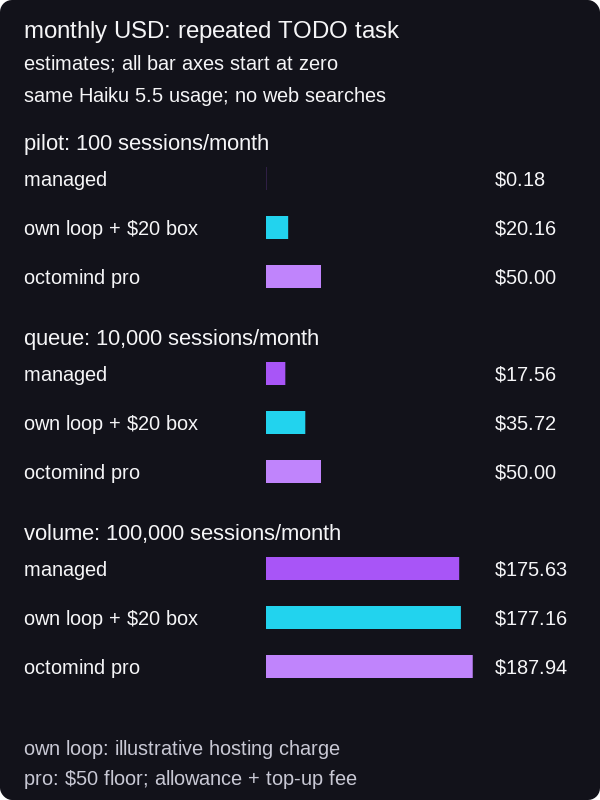
Source: author's 19 November 2026 session measurement, Anthropic pricing and Octomind plan facts; checked 19 November 2026. Hosting and monthly volumes are assumptions.
I build Octomind, an open-source coding agent, so I've included its hosted option with its subscription floor visible. This is a billing comparison, not a measured comparison of agent outcomes.
For that column, assume one small machine stays warm for 730 hours, uses one vCPU during each task, and has no other consumption. Octomind pro costs $50/month with $50 of usage. Its machine rates are $0.04/vCPU-hour while working and $0.012/GB-hour while warm; the small has 2 GB. Models are billed at provider prices. Prepaid usage beyond the allowance adds a 3% top-up fee.
The volume scenario consumes $157.16 in tokens, $9.23 in working CPU and $17.52 in warm memory. Consumption totals $183.92; the estimated cash cost is $50 + ($183.92 − $50) × 1.03, using unrounded inputs. Smaller scenarios stay inside the allowance but still cost $50. Top-ups have a $5 minimum, so cash purchased in a particular month can exceed consumption plus fees.
Pick the platform after changing those assumptions. If you already have spare hosting, the owned-loop estimate falls by $20. If the workload needs searches, add $0.01 per search to the Managed Agents estimate. Neither adjustment proves the same task will consume the same tokens elsewhere.
Claude Managed Agents vs Agent SDK: which should you host?
Choose by what you need to control: the loop, the execution environment or the whole service.
| Option | Who operates execution? | What you gain | What you still own or pay |
|---|---|---|---|
| Hosted Managed Agents | Anthropic | Hosted loop and sandbox | Tokens, running time, integration and output checks |
| Agent SDK on your machine | You | An agent runtime you can deploy yourself | Hosting and runtime operations |
| Own Messages API loop | You | Direct control over model/tool sequencing | Loop implementation, tools, isolation and hosting |
| Octomind cloud | Hosted machines | Routines and messenger entry points | Paid plan, usage and machine capacity planning |
Anthropic's docs distinguish its hosted harness from direct Messages API access. Agent SDK runs on your own machines; use it when you want a supplied runtime without outsourcing deployment. A custom Messages API loop gives you the sequencing responsibility as well. (Anthropic overview, checked November 2026; Anthropic migration guide, checked November 2026)
There are also two Managed Agents self-hosting variants. With self-hosted sandboxes, you operate tool execution while Anthropic keeps the service. With self-hosted Managed Agents, you operate both service and sandboxes. That includes the database and upgrades; its pricing requires an account-team quote, so the $20 owned-loop estimate above does not price that product. (Anthropic self-hosting docs, checked November 2026; Anthropic pricing, checked November 2026)
- Pick hosted Managed Agents if operating the loop and sandbox is work you want to delegate, and its data rules fit.
- Pick Agent SDK or your own loop if you need to own deployment; pick the custom loop when you also need to own sequencing. Using an existing machine avoids a new box bill, not API token charges.
- Pick a hosted platform such as Octomind if scheduled jobs and messenger access are part of the job. Its paid plans include routines and Telegram, Slack and WhatsApp entry points, but the subscription floor is material for occasional runs.
In our cloud setup, machines use a sysbox user namespace, a non-root agent and a disk quota; the recovery boundary is a machine rebuild. Capacity planning still matters on shared machines. On 24 October 2026, background video and voice jobs filled our shared 8 GB machine; the kernel killed processes 51 times. That incident is why I would check peak memory and concurrency before treating any box price as a complete hosting estimate.
How do you cap Claude Managed Agents spend on unattended sessions?
Attach a budget at creation and treat it as a per-session boundary. It's not a monthly spending limit.
This is the configuration from our measured session, verbatim:
budget={"type": "limit", "max_list_cost": {"amount": "100", "currency": "USD"}}"100" means $1.00, not $100. The cap compares public list cost, including runtime and searches. Enforcement happens between model requests: the crossing request finishes, so spend can exceed the cap. The session pauses with budget_reached. You can't attach a budget later to a session created without one. (Anthropic session budgets, checked November 2026)
For unattended work, review these settings before increasing volume:
- Permissions:
autoevaluates each call and may allow, deny or pause for approval. It is not a promise of unattended completion. The agent toolset defaults toalways_allow; MCP toolsets default toalways_ask. Our run usedautoand had no permission pauses. (Anthropic permission policies, checked November 2026) - Network: our environment used
networking: {"type": "limited"}with no hosts or package managers allowed. That starts with no allowed hosts. If you configure package installation in limited mode, also enableallow_package_managers; otherwise creation returns HTTP 400. (Anthropic environment setup, checked November 2026) - Schedule: deployments use cron expressions and an IANA timezone, starting new sessions. Their budget applies separately to every run. Scheduled execution has jitter, so do not use it as a precise deadline mechanism. (Anthropic scheduled deployments, checked November 2026)
Multiply the per-run ceiling by planned runs when estimating exposure, then allow for the documented request overshoot. Monitor actual totals as well; a configured ceiling is not expected consumption.
What data and platform limits rule out Claude Managed Agents?
Reject hosted Managed Agents if you require a retention or compliance arrangement it doesn't support. As checked on 19 November 2026, hosted transcripts persist until deleted; uploaded files need separate deletion. The hosted service is not Zero Data Retention eligible, and Managed Agents is not HIPAA eligible. (Anthropic overview, checked November 2026)
Self-hosting only the sandbox doesn't move transcript storage to you. Full-service self-hosting does: your database holds history, and your provider agreement governs model calls. An existing Anthropic ZDR arrangement can cover those model calls as it does other Messages API calls. You still need your own deletion policy for stored history, backups and exported telemetry. (Anthropic self-hosted data rules, checked November 2026)
For the Claude agents API integration, check these admission requirements:
| Check | Documented requirement or limit |
|---|---|
| Beta access | API key and anthropic-beta: managed-agents-2026-04-01 on requests |
| Platforms | Claude API, Claude Platform on AWS, Claude Models on Google Cloud (Anthropic managed) |
| Create endpoints | 300 requests/minute per organization |
| Read endpoints | 1,200 requests/minute per organization |
| Other ceilings | Organization spend and usage-tier rate limits also apply |
Those platform names do not mean every partner-operated model endpoint offers Managed Agents. Check the named service before planning a migration. (Anthropic overview, checked November 2026; Anthropic reference, checked November 2026)
How do you make your own monthly estimate?
Replace the fixture's counters with your own completed job's usage before choosing a host. Keep correctness and cost together: a cheap session that misses the deliverable is not the workload you meant to buy.
- Record uncached input, output, cache creation by lifetime, cache reads, searches and
usage.active_secondsafter the session goes idle. - Apply the selected model's rates, then multiply by expected monthly jobs. Add retries explicitly if your workload needs them.
- Compare managed runtime charges with your hosting quote, storage and operator time. For a subscription, apply its minimum and allowance before adding overage or top-up fees.
- Check the output against a task-specific acceptance test, then verify retention and approval handling before scheduling it unattended.
The worked estimates tell you how to calculate a bill; your own trace tells you which row you actually belong in.
Related reading: Claude API model prices · Cache lifetime and break-even math · What harness engineering changes · Hosted workflow execution