The competitor monitoring tool that only speaks up when something changed
Give an octo the pricing, feature and changelog pages you care about. It checks them on your schedule, compares them with what it saw last time and sends you the differences in Telegram, Slack or WhatsApp. A quiet week sends nothing.
Every Monday at 9, check acme.com/pricing and rival.io/pricing and tell me in Telegram only what changed since last week.
Nothing to install — working in 60 seconds. Cancel anytime.
How it works
-
Tell your competitor monitoring tool what to watch
Paste the pages and say what counts as a change: prices, plan limits, wording. Say "every Monday" and the octo saves the job as a routine, or set one up yourself under Routines.
-
It compares against last time
Each run opens the pages from its own cloud machine, compares them with the snapshot it saved in its folder last run, and writes the new one back. The first run only saves a baseline.
-
Only the changes reach you
Set it to report back when something changed: a run with nothing new sends nothing, and one that found something sends the differences to your connected chat or the panel.
Jobs to hand over
Track competitor prices every week
Every Monday at 9:00You say:“Check zapier.com/pricing and n8n.io/pricing. Compare them against what you found last time and tell me only what changed: prices, plans, wording. If nothing changed, say so in one line.”
What comes backThe first run saves a baseline; every run after that reports only the differences, or one line saying nothing changed.
Feature launches: their changelogs, read for you
Every weekday at 8:00You say:“Read rival.io/changelog and acme.com/changelog. List anything new since your last check, one line each with the link, and say which of it overlaps with what we sell.”
What comes backA short list of what they shipped, with links, and nothing on a quiet day.
Competitor price tracking for products
Every day at 7:00You say:“Check these eight product pages at two competing shops. Keep their prices in prices.csv and message me when one drops more than 5% or goes out of stock: <links>”
What comes backA running prices.csv in its files and a message only when a price crosses your line.
Positioning: catch a new headline
Every Friday at 16:00You say:“Compare the homepage headline and the top three feature claims on rival.io with last week's. If their positioning moved, quote the before and after.”
What comes backA before-and-after quote when their homepage pitch changes.
AI competitor analysis: a one-off teardown
OnceYou say:“Research our three closest competitors: what each charges, who it is for, what customers praise and complain about in public reviews. Write competitors.md with sources, then give me the short version.”
What comes backA sourced competitors.md in its files and the short version in the chat.
A real run: a baseline, then "Nothing changed"
On 10 October a Competitors octo on a demo account was asked to watch zapier.com/pricing and n8n.io/pricing. The first check had nothing to compare with, so it said so and saved a baseline: "No previous snapshot existed — this is the first check, so there's nothing to diff yet." It listed Zapier's plans, from "Free $0 (100 tasks/mo)" through "Team from $69/mo annual" to Enterprise. The second check, later the same day, came back in one line: "Nothing changed — both zapier.com/pricing and n8n.io/pricing are identical to the baseline captured earlier today (prices, plans, and wording all match)." Both checks together cost $0.66. The screenshot is a Competitors octo's page from another job: what it did, the files it wrote, and the offer to save the job as a routine.
Read how octos work →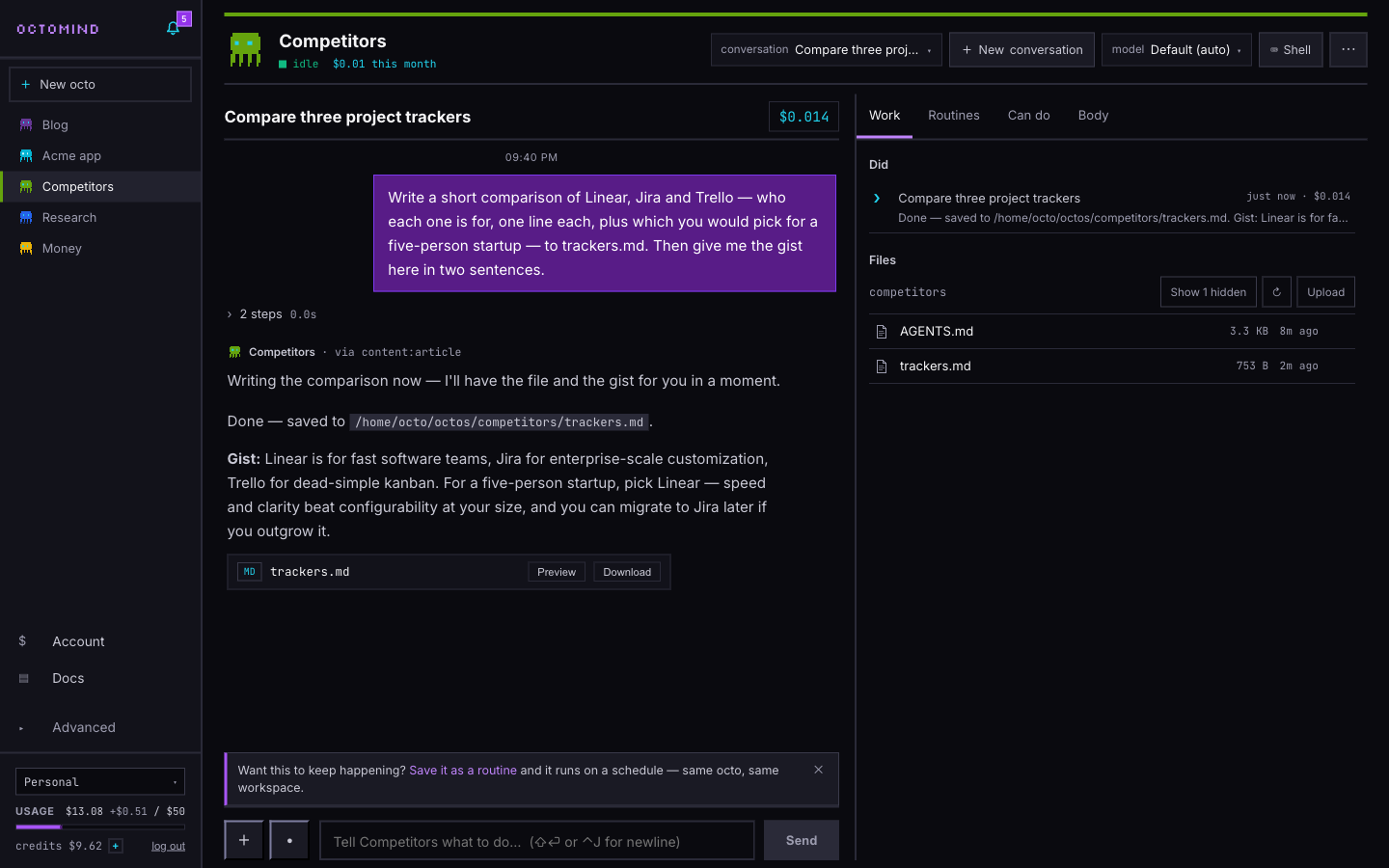
What it doesn't do
It reads public pages unless you sign in for it.
For a page behind an account, the octo opens a private browser window where you log in yourself; it keeps that session and never sees your password. It sees only what that account can see, so use one you would give a contractor. Read more →
Sites that block bots may not open.
Some shops and SaaS sites refuse automated browsers or show a captcha. The run then reports that it could not read the page or fails, and failures always reach you; for those pages, paste the page or a screenshot into the chat.
It checks on a schedule, not in real time.
Between runs it is not looking at the pages. Pro allows a run every 15 minutes at most, Max and Team every 5, so a price changed at 9:05 shows up in the next run.
No chat alert until you connect a chat.
Reports go to Telegram, Slack, WhatsApp or Discord once connected in Settings, to your inbox if an octo has an email address, and to the panel otherwise. WhatsApp only delivers inside its 24-hour window, and nothing goes out by SMS.
The cost cap flags a run; it does not cut it off.
Each routine has a max per run, $0.50 by default on Pro. A run that passes it is marked over budget and you get a note: raise the cap or watch fewer pages. Free has no routines. Read more →
Questions
What is a competitor monitoring tool?
Software that checks competitors' websites, prices and announcements and tells you what changed. Here it is an octo: you name the pages in plain words, it checks them on a schedule and reports only what differs from last time.
How do I track competitor prices automatically?
Ask an octo to check the pricing pages, compare them with last time and say how often. It runs the job as a routine, keeps a snapshot in its folder between runs and messages you when a price, plan or limit moves.
Will it message me when nothing changed?
Not if Report back is set to "when something changed": a run with nothing new sends nothing, and failures always come through. You can also add a check that runs first on the machine, so an unchanged page never calls a model.
Can it do AI competitor analysis, not just change alerts?
Yes, as a one-off job: name the competitors and it researches the web, writes a sourced report to its files and gives you the short version. Its sources are public pages and reviews, not paid data like traffic estimates.
Can it watch pages behind a login?
Yes, if you sign in for it. The octo opens a private browser window, you log in yourself, and it keeps that session in its own browser profile without ever seeing your password.
How much does competitor monitoring cost?
Routines need a paid plan: Pro is $20 for the first month, then $50 a month with $50 of usage included. The two checks above cost $0.66 together; press "Run it now" before saving a routine to see what one check of your pages costs.
More from Octomind Cloud
- Personal AI agent Your own AI agent for each thing you run, reporting back in Telegram, WhatsApp or Slack
- No-code agent builder Say the job in one sentence and get an agent with a cloud machine, memory and schedule.
- Agent hosting Skip the Mac mini: a managed machine that wakes for the job and sleeps for storage cost.
- Telegram AI agent Text your octo in Telegram: it does the job on its own computer and replies there
Reading
Sixty seconds to your first octo.
Subscribe and hand it the job — $20 your first month, cancel anytime. Nothing to install, so nothing to uninstall.